
You trust your home to keep your family safe. But every time a cleaning crew arrives with a bucket full of ammonia-based sprays, bleach solutions, and artificial-fragrance aerosols, they’re filling that sealed Minnesota home with an invisible chemical cocktail — one that sits in your air for hours after they leave.
If you have young children crawling on freshly mopped floors, a dog licking the baseboards, or a family member whose asthma flares up after cleaning day, this isn’t a minor concern. It’s a real, documented health risk — and it’s exactly why eco-friendly house cleaning in Minnesota has moved from a lifestyle preference to a practical necessity for thousands of families around Wayzata, Minnetonka, and the greater Twin Cities area.
Here’s what those standard cleaning products are actually doing inside your home — and what a genuinely non-toxic alternative looks like in practice.
The Hidden Danger in Your ‘Clean’ Home
Most conventional cleaning products work by applying chemistry that’s aggressive enough to dissolve grease, kill bacteria, and strip mineral deposits. That aggression doesn’t turn off the moment the cleaning is done. Volatile organic compounds (VOCs) — released by many standard cleaners, air fresheners, and disinfectant sprays — continue off-gassing into your indoor air for hours after application.
According to the U.S. Environmental Protection Agency, indoor air can be 2 to 5 times more polluted than outdoor air. In winter-sealed Minnesota homes, that number can be significantly higher.
Common culprits include:
- Ammonia (in glass and multi-surface cleaners) — triggers asthma and irritates the respiratory tract
- Sodium hypochlorite (bleach) — reacts with organic material to form chlorinated VOCs, linked to respiratory inflammation
- Phthalates (hidden inside ‘fragrance’) — endocrine disruptors associated with hormonal disruption in children
- 2-Butoxyethanol (in all-purpose cleaners) — linked to blood and kidney damage with repeated exposure
The issue isn’t that these products are outright toxic in a single exposure. It’s the accumulation: weekly cleaning, in a sealed home, over years. For children whose developing systems are far more sensitive to chemical exposure than adults, and for pets who spend their lives at floor level where residue concentrates, the math gets concerning fast.
Why Minnesota Homes Face a Unique Indoor Air Quality Problem
This is the angle that separates Minnesota families from the rest of the country — and it’s something almost no cleaning company talks about honestly.
From October through April, the average Minnetonka home is sealed. Storm windows closed. Furnace running. Fresh air exchange at a fraction of warm-weather levels. Whatever is in your indoor air in January is going to stay in your indoor air in January. There’s nowhere for it to go.
That means:
- Chemical VOCs from a Tuesday cleaning are still detectable in your air on Thursday
- Synthetic fragrances used to ‘freshen’ your home layer on top of residual cleaning chemicals
- Mold-fighting bleach products, used in bathrooms, spread chlorine gas into the connected air supply
- Dust disturbed during cleaning — containing pollen, pet dander, and dust mites — recirculates through a closed system
The Lake Minnetonka watershed also matters here. Whatever goes down your drains — from harsh surfactants to phosphate-based cleaners — enters a system that feeds the lakes this community depends on. Eco-friendly products aren’t just safer for your home. They’re safer for the water outside it.
Spring and fall in Minnesota bring their own air quality stress: ragweed and tree pollen push indoor allergen loads to seasonal peaks. If your cleaning products are also triggering reactions, allergy and asthma sufferers are getting hit from two directions at once.
What Genuinely Eco-Friendly Cleaning Does Differently
Safe for children — especially Minnesota’s long-indoor seasons
Children breathe more air relative to body weight than adults, and their immune and endocrine systems are still developing. The American Academy of Pediatrics has specifically flagged exposure to cleaning product chemicals as a concern in early childhood environments. During Minnesota’s long indoor season, reducing chemical load in the home air is one of the most direct actions a parent can take for their child’s respiratory health.
Safe for pets — who live where the residue lives
Dogs and cats spend their lives at floor level, grooming themselves with whatever has settled on the surface they’re walking on. Plant-based surfactants, hydrogen peroxide solutions, and microfiber-based mechanical cleaning leave no residue that poses a risk to animals. This is categorically different from the phenol-based disinfectants and synthetic fragrances found in conventional products.
Genuinely better for allergy and asthma sufferers
Cleaning should reduce allergen load — not add to it. Synthetic fragrances are among the most common non-food triggers for asthma attacks. Eliminating them from your home’s cleaning routine removes a recurring exposure risk that many allergy sufferers never identify as the source of their symptoms.
Better indoor air quality all winter
A home cleaned with plant-based products, enzyme cleaners, and hydrogen peroxide solutions smells clean in the most literal sense — because it is clean, not because it has been fragranced. That absence of synthetic scent, combined with no VOC off-gassing, means measurably better air quality in the space where your family spends the most time.
| Conventional Cleaning | Eco-Friendly Cleaning |
| VOC off-gassing for hours post-clean | Zero VOC formulations — no off-gassing |
| Synthetic fragrances (phthalates) | Essential oil or fragrance-free options |
| Bleach residue on surfaces | Hydrogen peroxide (breaks down to H₂O + O₂) |
| Ammonia-based glass cleaners | Vinegar + microfiber — streak-free, no fumes |
| Phosphates → lake algae bloom risk | Phosphate-free, biodegradable surfactants |
| Identical products regardless of your home | Customized based on your family’s sensitivities |
DIY Green Cleaning vs. Professional Eco-Friendly Service: What’s the Actual Difference?
The DIY path — vinegar, baking soda, castile soap — is genuinely effective for light maintenance and is far safer than conventional products. If you’re a detail-oriented person with time on your hands, you can maintain a clean, low-chemical home this way.
The gap shows up in three areas:
- Depth: Professional eco-cleaners reach the grout lines, behind appliances, and inside exhaust fans where DIY routines rarely go — and where allergen and mold load actually builds
- Technique: The difference between effective non-toxic cleaning and ineffective non-toxic cleaning is almost entirely in technique. Microfiber used correctly removes 99%+ of bacteria mechanically. Used incorrectly, it just spreads it
- Products: Consumer eco-products vary wildly in quality. Professional services use formulations that meet EPA Safer Choice certification — a higher bar than most store shelf ‘green’ products
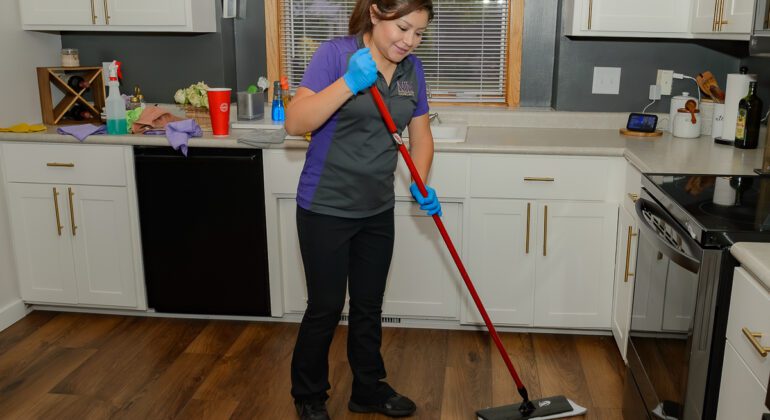
At MJM Cleaning Service, Tania Gordon’s team brings professionally formulated, non-toxic products to every job in Wayzata and Minnetonka — along with 10+ years of technique developed specifically for Minnesota homes. The result isn’t ‘clean enough without chemicals.’ It’s legitimately cleaner than most conventional cleaning jobs, with none of the chemical exposure.
How to Spot Greenwashing Before You Book
‘Natural.’ ‘Green.’ ‘Plant-based.’ None of these terms have regulatory definitions in the United States. They mean exactly what a marketing team decides they mean. Before you book any cleaning service claiming eco-friendly credentials, ask:
- Can you name the specific products you use? — Any legitimate eco-cleaning service knows their product list
- Are they EPA Safer Choice certified, Green Seal certified, or EWG-verified? — Third-party certification is the only meaningful green credential
- Do they use synthetic fragrances? — ‘Natural’ products with synthetic fragrance are not truly non-toxic
- Is ‘eco-friendly’ an optional upgrade or the standard? — It should be standard; an ‘eco surcharge’ is a red flag
MJM’s policy: eco-friendly products are not an upgrade option. They are the standard for every job — residential and commercial — at no premium charge. Product sheets available on request.
Eco-Friendly House Cleaning in Wayzata, Minnetonka & the Lake Minnetonka Area
If you’re searching for non-toxic cleaning services in Wayzata, Minnetonka, Plymouth, or anywhere along the Lake Minnetonka corridor, MJM Cleaning Service is the family-owned provider that’s been doing this work in this specific community for over a decade.
Tania Gordon founded MJM with the belief that the families she was cleaning for deserved to know exactly what was going into their home — and to feel good about it. That hasn’t changed. Every MJM team brings biodegradable, non-toxic, professionally formulated products to your door, uses microfiber technology to minimize chemical use further, and leaves behind nothing but a genuinely clean, fresh-smelling home.
No synthetic fragrances. No hidden VOCs. No compromise on results.
Ready for a home that’s actually clean — not just chemically fragranced? Call MJM: +1 800-999-9084 | mjmclean.com | Safe for kids. Safe for pets. Safe for Minnesota.
Frequently Asked Questions
Q: Is eco-friendly cleaning actually safe for newborns and infants?
Yes — and it’s arguably more important for newborns than any other age group. Infants spend significant time on floors, mouth surfaces, and inhale at a proportionally higher rate than adults. Plant-based, fragrance-free cleaning products present zero known risk at normal residential exposure. The same cannot be said for conventional products containing synthetic fragrances or VOC-releasing solvents.
Q: Does green cleaning actually kill germs and bacteria?
Yes. Hydrogen peroxide at appropriate concentrations disinfects to EPA-registered standards and has been validated against bacteria, viruses, and mold. Microfiber technology physically removes 99%+ of surface bacteria without any chemical. The myth that non-toxic means ‘less effective’ applies to 1990s-era green products — modern professional eco-formulations match or outperform conventional cleaners on every standard disinfection benchmark.
Q: My family member has asthma — will eco-friendly cleaning actually help?
Synthetic fragrances are among the most consistently identified non-food asthma triggers. Removing them from your cleaning routine eliminates a recurring exposure source. MJM uses fragrance-free options for clients with asthma, respiratory conditions, or chemical sensitivities — just let us know during your consultation and we’ll customize your clean accordingly.
Q: How do I know MJM’s products are genuinely non-toxic and not just marketed that way?
Ask us. Tania provides product data sheets and ingredient lists to any client who requests them. MJM selects products based on EWG (Environmental Working Group) ratings and EPA Safer Choice standards — not marketing language. If a product can’t pass that bar, it doesn’t enter a MJM client’s home.
Q: Is eco-friendly cleaning more expensive in Wayzata?
At MJM, no. Eco-friendly products are the MJM standard — not a premium tier. Standard house cleaning clients in Wayzata pay between $120 and $200 per visit depending on home size and needs. There’s no ‘green surcharge.’ Call +1 800-999-9084 for a free, transparent quote.
Q: How often should I schedule eco-friendly cleaning in Minnesota?
For most Minnetonka and Wayzata families, biweekly maintenance cleaning provides the best balance of clean indoor air and cost efficiency. During Minnesota’s high-allergen seasons (May pollen, August ragweed) and the sealed-home winter months, some families increase to weekly. MJM builds a schedule around your home’s actual needs — not a generic template.