
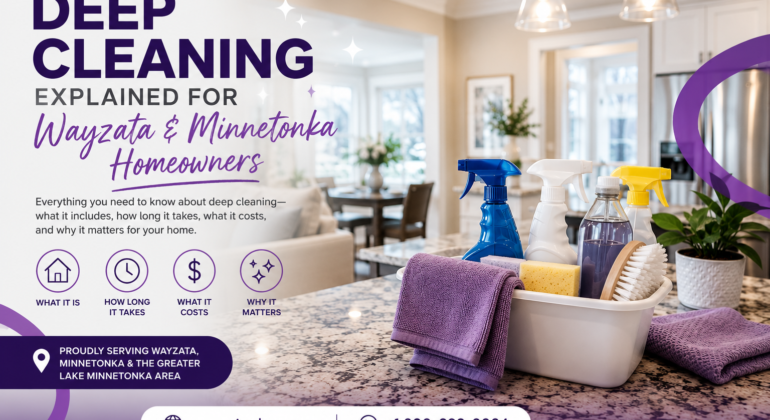
Deep Cleaning
If you’ve ever looked behind your refrigerator and wondered how six months of crumbs, dust, and mystery stickiness accumulated back there — you already understand why deep cleaning exists.
A deep cleaning is a thorough, top-to-bottom reset of your home that reaches every surface your regular weekly or biweekly cleaning doesn’t touch. We’re talking about behind and underneath appliances, inside cabinets, along every baseboard, inside window tracks, around light fixtures, and in the grout lines you stopped noticing somewhere around year two.
It’s not just “cleaning harder.” It’s a fundamentally different scope of work — one that takes a home from maintained-on-the-surface to genuinely, thoroughly clean in the places where dust, allergens, grease, and grime quietly build up over months.
For homeowners in Wayzata, Minnetonka, Plymouth, Orono, and Medina, deep cleaning carries some extra relevance that national cleaning guides never mention. Minnesota winters mean five-plus months of sealed windows, forced-air heating pushing dust through every room, and road salt and ice melt tracked through entryways onto hardwood and tile. Homes near Lake Minnetonka deal with seasonal humidity that can encourage mildew in bathrooms and basements. And if you own an older home in Wayzata or Minnetonka — many were built in the 1960s through 1980s — original cabinetry and woodwork can harbor decades of layered kitchen grease and grime that a routine cleaning never touches.
All of this is to say: if you live here, your home probably needs a deep cleaning more than the average article on the internet assumes.
What Does Deep Cleaning Include (and How Is It Different from Standard Cleaning)?
This is the question we hear most often at MJM, and it’s worth answering clearly because many cleaning companies blur the line between a “good cleaning” and an actual deep clean.
Standard (recurring) cleaning is maintenance. It’s the work that keeps your home looking and feeling tidy between visits — wiping countertops, vacuuming and mopping floors, cleaning toilets and sinks, spot-cleaning mirrors, taking out trash. A standard clean typically stays on visible, accessible surfaces. Your cleaner isn’t moving the couch, pulling out the oven, or climbing up to dust the top of the refrigerator.
Deep cleaning is a reset. It covers everything in a standard clean plus the work you’d do if you were preparing your home for sale, recovering from six months of winter, or just wanting to start fresh. Here’s what that actually looks like, room by room:
Kitchen: Pulling out the refrigerator and stove to clean behind and underneath them. Degreasing the range hood and exhaust fan. Cleaning inside the oven and microwave. Wiping down the interior and exterior of all cabinets. Cleaning the dishwasher interior. Scrubbing the sink, faucet, and backsplash tile/grout. Cleaning light fixtures and the tops of upper cabinets where grease film collects.
Bathrooms: Scrubbing tile grout on floors and shower walls. Removing soap scum and hard water deposits from shower doors, faucets, and showerheads. Cleaning behind and around the toilet base. Wiping down the interior of vanity cabinets. Scrubbing bathroom exhaust fans. Treating any mildew — common in Lake Minnetonka-area bathrooms where humidity from the lake can seep in during summer months.
Bedrooms and living areas: Vacuuming under beds and behind furniture. Cleaning baseboards, door frames, and light switch plates. Dusting ceiling fans and light fixtures (blade by blade, not just a quick swipe). Cleaning window sills, tracks, and blinds. Vacuuming upholstery and under cushions.
Entryways and mudrooms: In Minnesota homes, this area deserves its own callout. Five months of boots, coats, and road salt buildup means baseboards encrusted with dried salt residue, floor grout darkened by tracked-in grime, and closet floors that haven’t been swept since October. A deep clean addresses all of it.
Whole-home details: Cleaning air vents and return registers. Wiping down all door handles, cabinet pulls, and light switches. Dusting wall art frames, shelving, and decorative items. Cleaning interior windows (not exterior — that’s typically a separate service).
The key difference is thoroughness and access. A standard clean keeps up with life. A deep clean gets ahead of it.
How Long Does a Deep Cleaning Take?
The honest answer depends on three things: the size of your home, its current condition, and how many people are cleaning it. Here are realistic time estimates based on what we see cleaning homes across the Lake Minnetonka suburbs:
With a two-person professional crew (typical for MJM):
- 1,200–1,500 sq ft home (2–3 bedrooms, 1–2 baths): 3 to 4 hours
- 1,800–2,200 sq ft home (3–4 bedrooms, 2 baths): 4 to 5.5 hours
- 2,500–3,200 sq ft home (4 bedrooms, 2–3 baths): 5 to 7 hours
- 3,500–5,000+ sq ft home (common in Wayzata, Orono, and along the lake): 7 to 10+ hours, sometimes across two visits
Factors that add time:
- Pets: Homes with dogs or cats add 30–60 minutes for pet hair removal from upholstery, baseboards, and vents.
- Deferred maintenance: If it’s been a year or more since any professional cleaning — or if the home has never been professionally deep cleaned — expect the upper end of these ranges.
- Post-winter cleans (March–May in Minnesota): After a full winter of sealed windows and salt-tracked floors, these cleans consistently take longer. This is our busiest deep-cleaning season, and with good reason.
- Lake homes and seasonal properties: Cabins or lake houses in Orono, Medina, or along Lake Minnetonka that sit partly vacant during off-season months accumulate dust, cobwebs, and sometimes mildew faster than year-round residences.
If you’re doing a deep clean yourself (no judgment — we respect the ambition), budget roughly double the times above. A professional crew brings the tools, products, and muscle memory that make the work dramatically faster.
How Much Does a Deep Cleaning Cost in the Wayzata and Minnetonka Area?
Let’s talk real numbers. Here’s what you can expect to pay for professional deep cleaning in the western Twin Cities suburbs as of 2026:
Deep cleaning (one-time or first-time clean):
- 1,200–1,500 sq ft home: $250–$350
- 1,800–2,200 sq ft home: $300–$425
- 2,500–3,200 sq ft home: $375–$500
- 3,500–5,000+ sq ft home: $500–$700+
For comparison, standard recurring cleaning in this market:
- A 2,000 sq ft home on a biweekly schedule typically runs $150–$250 per visit.
- Deep cleans and first-time cleans are priced higher because they involve significantly more labor, more time, and more detailed work.
What drives the price range? Same factors as time: home size, number of bathrooms (bathrooms are the most labor-intensive rooms), current condition, pets, and any add-on services you request (interior windows, inside the refrigerator, inside the oven, etc.).
A few things worth noting about pricing in this area specifically:
The western suburbs — Wayzata, Minnetonka, Orono, Medina, Plymouth — tend to run at or slightly above Minneapolis-proper averages for cleaning services. Homes in this area are typically larger, many have custom finishes that require careful handling (stone counters, hardwood, custom cabinetry), and clients here generally expect a higher standard of detail. National franchise companies operating in this market (Merry Maids, The Maids, Molly Maid) often quote similar or higher rates, but with less flexibility and transparency about what’s actually included.
At MJM, we provide a free quote based on your specific home — no surprises, no hidden fees, and no obligation.
Is Deep Cleaning Necessary? (When It’s Worth It — and When It’s Not)
The honest answer: it depends on where you’re starting from.
A deep clean is absolutely worth it if:
- You’re booking professional cleaning for the first time. A deep clean establishes a clean baseline. Without it, your recurring cleaner will spend visit after visit chipping away at old buildup instead of maintaining a genuinely clean home. Most cleaning companies (MJM included) recommend — or require — a deep clean or first-time clean before starting recurring service. It’s not an upsell; it’s how the system works.
- It’s been 6+ months since your last deep clean. Even with excellent weekly cleaning, grime accumulates in the places weekly cleaning doesn’t reach. Grout darkens. Grease builds on range hoods. Dust collects on ceiling fan blades and inside vents. Every 3 to 6 months is the sweet spot for most households.
- You’ve just survived a Minnesota winter. After five months of closed windows and the furnace running, indoor dust levels spike. Add in road salt residue and mud-season tracking, and spring deep cleaning isn’t just tradition — it’s maintenance.
- You’re moving in or out. A deep clean protects your security deposit (if renting) or presents your home at its best (if selling). In this market, a pre-listing deep clean can meaningfully affect buyer perception. Move-in cleans give you a genuinely fresh start.
- Allergies or respiratory concerns. Deep cleaning removes the allergens — dust mites, pet dander, mold spores — that hide in ductwork, upholstery, and the places regular cleaning can’t access. If someone in your household deals with asthma or seasonal allergies, a deep clean twice a year can make a noticeable difference.
- You’re hosting a holiday gathering, an event, or out-of-town guests. Especially around the Lake Minnetonka summer season when guests and family visit.
- Seasonal lake-home openings. Many Orono and Medina homeowners keep lake properties that sit empty for parts of the year. A deep clean before the summer season handles the dust, cobwebs, and musty air that accumulate.
A deep clean might not be necessary if:
- You already have a consistent biweekly or weekly professional cleaning schedule and your cleaner addresses detail work on a rotating basis.
- Your home was professionally deep cleaned within the last 2 to 3 months and doesn’t have heavy foot traffic, pets, or kids.
When in doubt, ask your cleaning company. Any reputable cleaner will be straight with you about whether you need a deep clean or whether a standard clean will do the job.
The Benefits of Deep Cleaning Services (Beyond a Spotless House)
Most articles list “a cleaner house” as a benefit of deep cleaning, which isn’t exactly a revelation. Here’s what actually changes when your home gets a real deep clean:
Your indoor air quality improves measurably. Forced-air heating and cooling systems circulate whatever’s in your ducts — dust, pet dander, pollen, mold spores. A deep clean addresses air vents, returns, ceiling fans, and the surfaces where these particles settle. In Minnesota, where your home is sealed tight for nearly half the year, this matters more than it does in climates where you can open the windows year-round.
Your home stays cleaner, longer. Once buildup is removed — grease on range hoods, soap scum in tile grout, dust behind furniture — regular maintenance cleaning becomes more effective. Your biweekly cleaner can actually maintain instead of fighting a losing battle against layers of old grime.
You protect surfaces and finishes. Grout that stays dirty long enough absorbs stains permanently. Grease on range hoods and backsplash can etch certain surfaces. Hard water deposits on faucets and shower doors pit the finish over time. A periodic deep clean isn’t just cosmetic — it preserves the materials in your home.
Stress goes down. There’s research behind this — a cluttered, grimy environment correlates with higher cortisol levels and lower mood. You don’t need a study to know how it feels to walk into a home that’s been truly, thoroughly cleaned. The difference between “tidy” and “deep cleaned” is something you can feel.
You catch problems early. When a professional deep cleans behind your appliances, under sinks, and inside cabinets, they often spot early signs of leaks, pest activity, mold, or water damage that you wouldn’t otherwise see until the problem became expensive.
How to Remove Built-Up Grime During Deep Cleaning (DIY Methods That Actually Work)
Whether you’re tackling a deep clean yourself or just want to maintain problem spots between professional visits, here are the approaches we use and recommend — with products that won’t damage your surfaces or your health.
For kitchen grease buildup (range hoods, backsplash, cabinet faces):
Mix a tablespoon of dish soap (the grease-cutting kind — Dawn or similar) into a spray bottle of warm water. Spray the greasy surface, let it sit for 2 to 3 minutes to break down the grease, and wipe with a microfiber cloth. For heavy buildup — the kind you see on range hood filters and the tops of upper cabinets — make a paste of baking soda and a few drops of dish soap, apply it, let it sit for 5 minutes, and scrub with a non-abrasive sponge. Rinse thoroughly and dry.
For bathroom tile grout (soap scum and mildew):
Sprinkle baking soda along the grout lines, spray with white vinegar (it will fizz — that’s the reaction doing the work), and let it sit for 5 to 10 minutes. Scrub with a stiff-bristle grout brush or an old toothbrush. For grout that’s darkened with mildew, a paste of baking soda and hydrogen peroxide left on for 10 to 15 minutes is more effective. Rinse well with clean water.
For hard water deposits on faucets and shower doors:
Soak a cloth or paper towels in white vinegar and wrap them around the faucet or press them against the glass. Leave them in place for 15 to 30 minutes (the acid needs dwell time to dissolve mineral deposits). Wipe clean and buff dry.
For baseboard and trim grime (the Minnesota winter special):
A damp microfiber cloth with a small amount of all-purpose cleaner handles most baseboard grime. For the salt-and-mud buildup that encrusts baseboards near Minnesota entryways every winter, add a splash of white vinegar to your cleaning water — it cuts through the mineral residue from road salt more effectively than soap alone. Wipe in one direction, rinsing your cloth frequently.
For hardwood floor buildup:
Never use vinegar directly on hardwood — it can damage the finish over time. Instead, use a damp (not wet) microfiber mop with a pH-neutral hardwood floor cleaner. For sticky spots or waxy buildup, a small amount of rubbing alcohol on a cloth works without harming the finish.
For woodwork and cabinet grime:
A solution of warm water with a drop of dish soap handles most surface grime. For older Wayzata and Minnetonka homes with original wood cabinetry that’s developed a sticky, yellowed film (usually a combination of cooking grease and aged polyurethane), a mix of equal parts olive oil and white vinegar applied with a soft cloth can cut through the buildup and restore some luster. Always wipe in the direction of the wood grain, and dry immediately.
What DIY methods miss
The tips above will handle individual problem spots. What they won’t do is give you the systematic reset that a professional deep clean provides. A pro crew works methodically — top to bottom, left to right — so nothing gets skipped. They move appliances you can’t move alone. They have commercial-grade tools for grout, vents, and under-appliance areas. And they do it in 4 to 6 hours instead of a full weekend.
If you want a genuine reset — not just clean counters but the feeling of walking into a home where every surface, every corner, every hidden spot has been addressed — that’s where professional deep cleaning earns its price.
Ready for a Deep Clean? Here’s How to Get Started with MJM
If you’ve read this far, you probably already know whether your home needs a deep cleaning. Here’s how we make the process simple:
Step 1: Request a free quote. You can book online through our scheduling page or contact us directly. Tell us about your home — size, number of bedrooms and bathrooms, how long since the last deep clean, and any specific concerns (pets, allergies, post-winter mess, etc.). We’ll give you a clear price with no hidden fees.
Step 2: We schedule around you. We offer flexible scheduling Monday through Saturday. Most deep cleans are scheduled during normal business hours so we can use natural light to spot every detail, but we’ll work with your calendar.
Step 3: We show up with everything. MJM brings all professional-grade supplies and equipment — including our eco-friendly, non-toxic products that are safe for kids, pets, and allergy-sensitive households. You don’t need to provide anything.
Step 4: We clean. You come home to a reset. Our trained, background-checked crew works through your home top-to-bottom. When we’re done, you get the walk-through. If anything isn’t right, we’ll come back within 24 hours and address it at no charge.
No contracts. No long-term commitments. Many clients start with a one-time deep clean and then transition to recurring biweekly or monthly service — but that’s completely your call. We earn your repeat business by earning it, not by locking you into paperwork.
MJM Cleaning Services is a family-owned company based at 1250 Wayzata Blvd E, Wayzata, MN, serving Wayzata, Minnetonka, Plymouth, Orono, and Medina. Call us at +1 800-999-9084 or request your free quote online.