

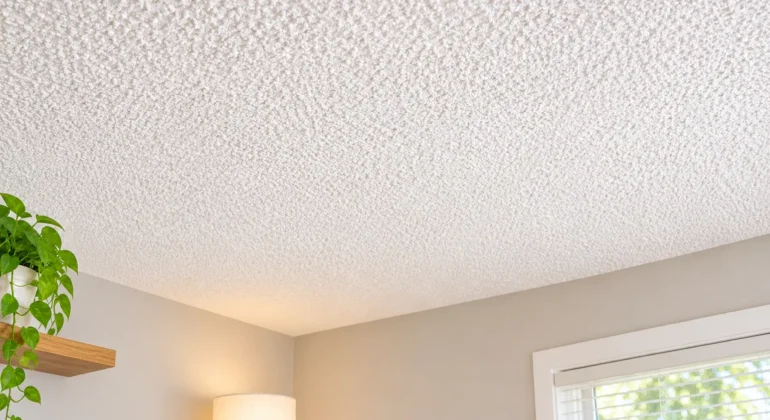
Cleaning a popcorn ceiling can be frustrating. Dust settles between the raised bumps, cobwebs cling to the texture, and even a little too much pressure can leave behind a noticeable bare patch. Unlike a smooth ceiling, a textured finish requires a more careful approach.
Before touching your ceiling, establish whether it may contain asbestos. If the material is suspect or its composition is uncertain, leave it undisturbed and seek professional guidance.
Once hazardous-material concerns have been resolved, the best way to clean a popcorn ceiling is to remove loose dust with a soft, dry duster or a vacuum fitted with a suitable soft brush attachment. Small stains on washable painted ceilings may respond to mild detergent, but unpainted textures should generally be kept dry.
At MJM Cleaning Services, we believe that a good cleaning method should protect the surface as well as remove dirt. Here’s how to approach popcorn ceiling cleaning, which tools to use and when you’re better off leaving the ceiling alone.
Is It Safe to Clean Your Popcorn Ceiling?
Before gathering your cleaning supplies, consider two things: what your ceiling is made of and whether the texture is in good condition. Neither should be overlooked, particularly in older homes.
Could Your Popcorn Ceiling Contain Asbestos?
Some popcorn ceiling materials contain asbestos. Although the concern is generally greater in older properties, the age of your home alone cannot confirm whether the ceiling is asbestos-free.
The Minnesota Department of Health identifies popcorn ceiling texture as one of the building materials that may contain asbestos.
According to the US Environmental Protection Agency (EPA), disturbing asbestos-containing materials can release microscopic fibers into the air. You generally cannot identify asbestos simply by looking at a material.
If your ceiling may contain asbestos:
- Do not dust, brush, vacuum, wash or scrape it.
- Do not collect a material sample yourself.
- Do not sweep or vacuum fallen ceiling debris.
- Keep children and pets away from damaged material.
- Contact a qualified asbestos professional for appropriate advice.
A household HEPA vacuum, ordinary dust mask or coat of ceiling paint does not make disturbing asbestos-containing material safe.
This does not mean every popcorn ceiling needs to be removed. Intact asbestos-containing materials that will remain undisturbed can often be left in place.
Minnesota homeowners can use the state’s Asbestos Contractor Search to find qualified professionals.
Check the Condition of Your Ceiling
Even when asbestos has been ruled out, some ceilings are too fragile or damaged for ordinary cleaning.
| Ceiling Condition | What You Should Do |
|---|---|
| Suspected or confirmed asbestos | Leave undisturbed and seek specialist guidance |
| Dry, stable texture without hazardous-material concerns | Begin with gentle dry cleaning |
| Stable, washable painted texture | Consider limited spot cleaning if necessary |
| Crumbling, peeling or cracked texture | Stop and have the condition assessed |
| Damp ceiling or suspected mold | Investigate the moisture problem |
| Bulging or sagging ceiling | Keep people away and obtain prompt professional assessment |
Older painted surfaces can also present lead-related concerns, particularly in homes built before 1978. If paint is deteriorating or its composition is uncertain, consult the EPA’s lead exposure guidance before disturbing it.
All cleaning instructions in this guide apply only to stable ceilings where relevant hazardous-material concerns have been resolved.
Painted vs. Unpainted Popcorn Ceilings
The type of finish determines how much cleaning your ceiling can tolerate.
Unpainted popcorn texture is generally porous and vulnerable to moisture. Wet cleaning can soften the material, loosen the raised particles and create permanent patches.
Painted popcorn ceilings may be more durable, but not all ceiling paints are washable. Flat and matte finishes can be especially sensitive to rubbing and moisture.
| Cleaning Method | Unpainted Popcorn Ceiling | Washable Painted Popcorn Ceiling |
|---|---|---|
| Soft, dry duster | Suitable if stable | Suitable if stable |
| Vacuum with soft brush | Use cautiously | Use cautiously |
| Barely damp sponge | Avoid | Limited spot cleaning |
| Mild dish soap and water | Avoid | Only after compatibility testing |
| Direct water spraying | Avoid | Avoid |
| Steam cleaning or scrubbing | Avoid | Avoid |
If you’re unsure whether the ceiling has been painted, check renovation records or ask the previous homeowner. Do not scratch or scrape the texture to identify the finish.
Sherwin-Williams’ painted surface maintenance guidance recommends mild, nonabrasive cleaners and testing the cleaning solution on an inconspicuous area.
These general painted-surface recommendations should not be interpreted as permission to wash every painted popcorn ceiling. If you cannot establish that the coating is washable, avoid damp cleaning.
What You Need to Clean a Popcorn Ceiling
You probably already have most of the tools needed for routine dust removal. The important thing is choosing equipment that won’t snag, scrape or pull away the texture.
| Tool or Supply | Purpose |
|---|---|
| Soft microfiber or feather duster | Removing loose surface dust |
| Extendable cobweb duster | Reaching corners and ceiling edges |
| Vacuum with adjustable suction and a soft dusting brush | Collecting loose dust on stable texture |
| Drop cloths | Protecting floors and furniture |
| Protective eyewear | Keeping ordinary falling dust out of your eyes |
| White, nonabrasive sponge | Spot cleaning washable painted finishes |
| Mild dish soap | Treating small surface grease marks on compatible finishes |
Avoid stiff brushes, abrasive sponges, rotating vacuum heads, sticky lint rollers and steam cleaners. They can damage delicate surfaces even when used on asbestos-free ceilings.
An extension pole is particularly useful because it allows you to reach many ceilings without climbing a ladder.
How to Clean a Popcorn Ceiling Without Damaging It: 5 Steps
Once you’ve established that your ceiling is suitable for ordinary cleaning, start with the gentlest method. You can always reassess a remaining mark later, but damaged texture is much harder to restore.
Step 1: Prepare the Room
Move small furniture, electronics and decorations away from the area. Cover larger furniture and flooring with clean drop cloths to catch ordinary dust.
Switch off ceiling fans and allow the blades to stop completely. Avoid getting moisture near electrical fixtures.
For ceilings above staircases or in rooms with unusually high ceilings, use a suitable extension tool from a stable position. Never stand on furniture or balance a regular ladder across uneven steps. If you cannot reach the area safely, leave it for an appropriately equipped professional.
Step 2: Test a Small Area First
Choose an inconspicuous corner and lightly pass a soft duster over a small section of the ceiling.
Check whether the texture remains intact. If you notice paint flakes, ceiling particles or changes in the surface, stop. Even a ceiling that does not contain asbestos may be too fragile for routine dusting.
A successful test also helps you determine how much pressure the surface can tolerate.
Step 3: Remove Dust and Cobwebs
Start along the ceiling edges and corners, then work across small sections of the room. Use a soft duster with minimal pressure, allowing its fibers to collect the dust rather than pressing into the raised texture.
If you’re using a vacuum cleaner, attach a soft dusting brush and select the lowest effective suction setting. Let the suction collect loose dust with minimal contact between the attachment and ceiling.
When removing cobwebs, gently lift them away instead of dragging them across the surface. Dragging can snag the texture and spread the accumulated dust.
Clean the duster as it becomes dirty. If dust remains embedded between the bumps, avoid making repeated, increasingly aggressive passes over the same area.
Step 4: Spot Clean Stains Only If the Finish Is Washable
Skip this step for unpainted ceilings or finishes with uncertain washability.
For a stable, washable painted ceiling, mix a few drops of mild dish soap into a bowl of lukewarm water, provided the coating manufacturer’s care instructions permit it.
Dip a soft white sponge into the solution and wring it out thoroughly. Test a small hidden area and allow it to dry completely.
If there is no change in color, paint or texture, gently dab the affected spot. Use a separate, barely damp sponge to remove any remaining soap.
Do not spray the solution directly onto the ceiling, saturate the texture or scrub the stain. Stop if the sponge picks up paint or the ceiling material begins to soften.
Step 5: Inspect the Ceiling Before Finishing
Check the cleaned area in daylight or from different angles. A damp spot may look darker temporarily, so allow it to dry before judging the result.
If the texture remains intact, remove the protective coverings and clean any ordinary household dust that has settled on furniture and floors.
If a stain remains after drying, resist the urge to apply a stronger chemical. Persistent discoloration may require a different solution, including professional painting or repair.
How to Remove Stains From a Popcorn Ceiling
One of the most common mistakes homeowners make is treating every ceiling mark as dirt. Some discoloration results from grease or smoke, while other marks point to moisture problems or deteriorating materials.
Understanding the likely cause can help you avoid damaging the ceiling while trying to improve its appearance.
| Ceiling Problem | Possible Cause | Recommended Approach |
|---|---|---|
| Gray dust and cobwebs | Airborne household dust | Gentle dry cleaning |
| Sticky yellow marks above a stove | Cooking grease | Limited spot cleaning on a washable finish |
| Widespread yellow discoloration | Smoke, aging paint or accumulated residue | Assess the cause and coating condition |
| Brown or tan rings | Previous or active water damage | Investigate the moisture source |
| Dark spots and musty odors | Possible mold or excess moisture | Seek appropriate assessment |
| Dark marks around air vents | Dust deposits or other building conditions | Investigate before repeated cleaning |
How to Clean Grease From a Popcorn Ceiling
Cooking releases airborne grease that can settle on kitchen ceilings. Over time, dust sticks to the residue, creating darker or yellowish patches above the stove.
For a stable, washable painted ceiling, a mild dish soap solution may help remove a small surface grease mark. Use the patch-testing and gentle blotting method described earlier.
If the ceiling is unpainted or the grease has penetrated deeply into the texture, wet cleaning may do more harm than good. Avoid strong degreasers, abrasive pads and repeated washing.
For extensive buildup, a painting professional experienced with textured ceilings may be able to recommend a suitable restoration approach once material safety has been established.
Using an externally vented kitchen exhaust fan while cooking can help reduce future buildup.
How to Remove Smoke and Yellow Stains
Yellow ceiling discoloration can develop from cigarette smoke, cooking residue, aging paint or other deposits. The color alone doesn’t establish the cause.
A washable painted ceiling may respond to gentle cleaning with mild detergent. However, long-standing smoke residue and discoloration that has penetrated the finish can be difficult to remove completely.
If gentle cleaning doesn’t improve the appearance, further washing may create uneven patches instead of removing the stain.
After the underlying cause and any material safety concerns have been addressed, a painting professional can advise whether a compatible stain-blocking primer and repainting are appropriate.
How to Deal With Brown Water Stains
Brown rings and irregular tan patches often indicate previous or ongoing water intrusion. These are not stains you should immediately try to wash away.
In Maple Grove and other Minnesota communities, new ceiling marks appearing during winter or snowmelt may be associated with roof leaks or ice dams. Plumbing leaks and condensation are also possible causes.
The University of Minnesota Extension explains how ice dams can allow water to enter a home and damage ceilings, walls and insulation.
Before treating the appearance of a water stain, identify and repair the moisture source. The affected materials must also be assessed and properly dried.
Do not wash, paint over or puncture a sagging ceiling. Keep people away from the area and arrange prompt professional assistance. If water is near electrical fixtures, avoid touching the affected equipment.
What If You Suspect Mold?
Dark spots, persistent dampness and musty odors may indicate mold growth. However, not every dark ceiling mark is mold, and color alone cannot establish what you’re dealing with.
The EPA’s mold cleanup guidance explains that mold can penetrate porous building materials, making complete cleaning difficult.
The underlying moisture problem needs to be corrected, and affected materials may require removal or replacement.
Avoid spraying bleach, vinegar or other household chemicals onto suspected mold on popcorn ceilings. Do not use bleach as a test to determine whether a stain is mold.
Because the texture is porous and may have additional material safety concerns, seek appropriate professional assessment rather than treating it as an ordinary household cleaning task.
What to Do If Your Popcorn Ceiling Starts Falling Apart
If small pieces of the ceiling come away while dusting, stop immediately. Continuing to clean can enlarge the damaged area and make repairs more difficult.
| What You Notice | What to Do Next |
|---|---|
| Texture particles falling during dusting | Stop and assess the ceiling’s condition |
| Paint transferring onto the sponge | Discontinue damp cleaning |
| Cleaned areas looking lighter than surrounding areas | Allow the surface to dry and avoid further scrubbing |
| Stains returning after cleaning | Investigate the underlying cause |
| Texture becoming soft or peeling | Stop applying moisture |
| Suspected asbestos debris on the floor | Leave it undisturbed and contact an asbestos professional |
If you have already vacuumed a ceiling that may contain asbestos, stop using the vacuum. Do not empty it or attempt to clean its filters. Keep people away from the affected material and obtain professional advice about the equipment and surrounding area.
Never assume falling ceiling particles are harmless simply because they look like ordinary white dust.
Popcorn Ceiling Cleaning Mistakes to Avoid
Cleaning more aggressively does not necessarily produce a better result. With textured ceilings, it can create permanent damage.
- Using too much water: Excess moisture can loosen the texture and affect the paint.
- Using a lint roller: Adhesive may pull away fragile ceiling particles.
- Scrubbing with a Magic Eraser or stiff brush: Abrasion can remove paint or flatten the texture.
- Using a rotating vacuum attachment: Moving brushes can damage the raised surface.
- Spraying bleach or strong degreasers: These products may discolor or damage the finish.
- Using steam cleaners: Heat and moisture are unsuitable for delicate popcorn textures.
- Cleaning over water damage: Removing a visible mark does not resolve the underlying leak.
Never mix bleach with ammonia, vinegar or other cleaning products. For ordinary popcorn ceiling cleaning, stronger chemicals are generally unnecessary.
How to Keep Popcorn Ceilings Clean for Longer
You can reduce ceiling buildup by controlling dust, cooking residue and moisture elsewhere in your home.
Regularly clean accessible ceiling fan blades, furniture, floors and other suitable household surfaces. Maintain your HVAC filters according to the manufacturer’s instructions, and use kitchen and bathroom exhaust fans to help control grease and humidity.
The Minnesota Department of Health’s mold and moisture guidance recommends correcting leaks, reducing condensation and using appropriate ventilation to control indoor moisture.
There is no universal popcorn ceiling cleaning schedule. Inspect suitable ceilings every few months and clean them only when necessary. Rooms with ceiling fans or frequent cooking activity may accumulate dirt more quickly than less frequently used spaces.
Regular household maintenance can reduce the need for frequent ceiling cleaning. Our recurring house cleaning services in Maple Grove help homeowners manage everyday dust, kitchens, bathrooms and floors throughout the year.
When Should You Hire a Professional?
If the ceiling is unusually high, heavily stained, damaged or unsafe to disturb, further DIY attempts may make the situation worse.
The right professional depends on the problem.
| Ceiling or Cleaning Problem | Who to Contact |
|---|---|
| Unknown or suspected asbestos-containing texture | Qualified asbestos inspector |
| Asbestos-containing material requiring intervention | Appropriately licensed asbestos contractor |
| Plumbing-related ceiling leak | Plumber |
| Roof leak or ice dam damage | Roofing or building professional |
| Suspected mold or extensive water damage | Qualified mold or water damage specialist |
| Persistent discoloration or damaged texture | Painting or ceiling repair professional |
| Ordinary household cleaning and maintenance | Residential cleaning company |
A routine house cleaning appointment is not a substitute for asbestos assessment, hazardous-material cleanup or ceiling restoration.
If you’re booking professional house cleaning, explain any unusual ceiling conditions, suspected hazardous materials or damaged surfaces before the appointment.
Frequently Asked Questions
What is the best way to clean a popcorn ceiling?
Gentle dry dusting with a soft, extendable duster is usually the best starting method for a stable ceiling where hazardous-material concerns have been resolved. Avoid unnecessary moisture, pressure and abrasive tools.
Can you vacuum a popcorn ceiling without damaging it?
A vacuum with adjustable suction and a suitable soft brush attachment can remove loose dust from a stable ceiling. Use gentle suction and minimal surface contact. Never vacuum a ceiling or fallen debris suspected of containing asbestos.
Can I use a Swiffer to clean my popcorn ceiling?
A soft, dry Swiffer-style duster may be suitable for a stable ceiling if it does not snag the texture. Avoid wet cleaning pads and pressing the duster firmly against the surface.
How do you clean an unpainted popcorn ceiling?
Stick to gentle dry cleaning, provided the ceiling is stable and hazardous-material concerns have been resolved. Unpainted texture is vulnerable to moisture, so washing or applying cleaning solutions can cause damage.
Can you clean a popcorn ceiling with vinegar and water?
Vinegar is not recommended as a general popcorn ceiling cleaner. Moisture can damage unpainted texture, and acidic cleaning solutions may be incompatible with some painted finishes. Use manufacturer-approved cleaning methods instead.
Why does my popcorn ceiling look patchy after cleaning?
Patchiness can result from uneven dust removal, moisture, paint damage or the loss of small texture particles. Allow the area to dry completely before assessing it. If the finish has been damaged, further scrubbing is unlikely to help.
Can you paint over a dirty popcorn ceiling?
Painting may improve persistent discoloration, but it is not a substitute for correcting grease buildup, leaks, mold or hazardous-material concerns. Have the ceiling assessed and obtain suitable surface preparation advice before painting.
How often should I dust a popcorn ceiling?
Inspect it periodically and clean it only when necessary, provided the material is safe and stable. Avoid unnecessary repeated cleaning, particularly if the texture is delicate.
Should I clean a popcorn ceiling before moving out?
Only if the material and finish are appropriate for ordinary cleaning. Renters who are unsure about asbestos, ceiling condition or permitted cleaning methods should contact their landlord or property manager before attempting the work.
Need Help Keeping Your Maple Grove Home Clean?
Looking after your home shouldn’t mean spending every weekend catching up with cleaning. Regular attention to floors, bathrooms, kitchens and accessible household surfaces can make everyday maintenance much more manageable.
MJM Cleaning Services is a local, family-owned residential cleaning company based in Maple Grove, Minnesota. Our founder, Tania, established the business in 2023 and brings approximately 10 years of cleaning industry experience, including previous work at North Memorial Hospital.
We offer personalized cleaning plans, detailed checklists and responsive communication because every household has different needs. Our residential cleaning services are also backed by a 24-Hour Clean Warranty, subject to our service terms.
Whether you need ongoing house cleaning in Maple Grove or want to catch up with everyday household buildup through our deep cleaning services, we’ll discuss your priorities and agree on an appropriate cleaning plan before your appointment.
We serve Maple Grove, Plymouth, Wayzata, Minnetonka, Rogers and surrounding Twin Cities communities.
Request Your Free House Cleaning Quote or call (800) 999-9084 to discuss your home’s cleaning needs.
About This Guide
Prepared by MJM Cleaning Services using residential cleaning resources, paint manufacturer maintenance recommendations and authoritative homeowner safety guidance from the US Environmental Protection Agency, Minnesota Department of Health and University of Minnesota Extension. References were checked in November 2026 for this 2027 guide.